
What is normal barometric pressure?
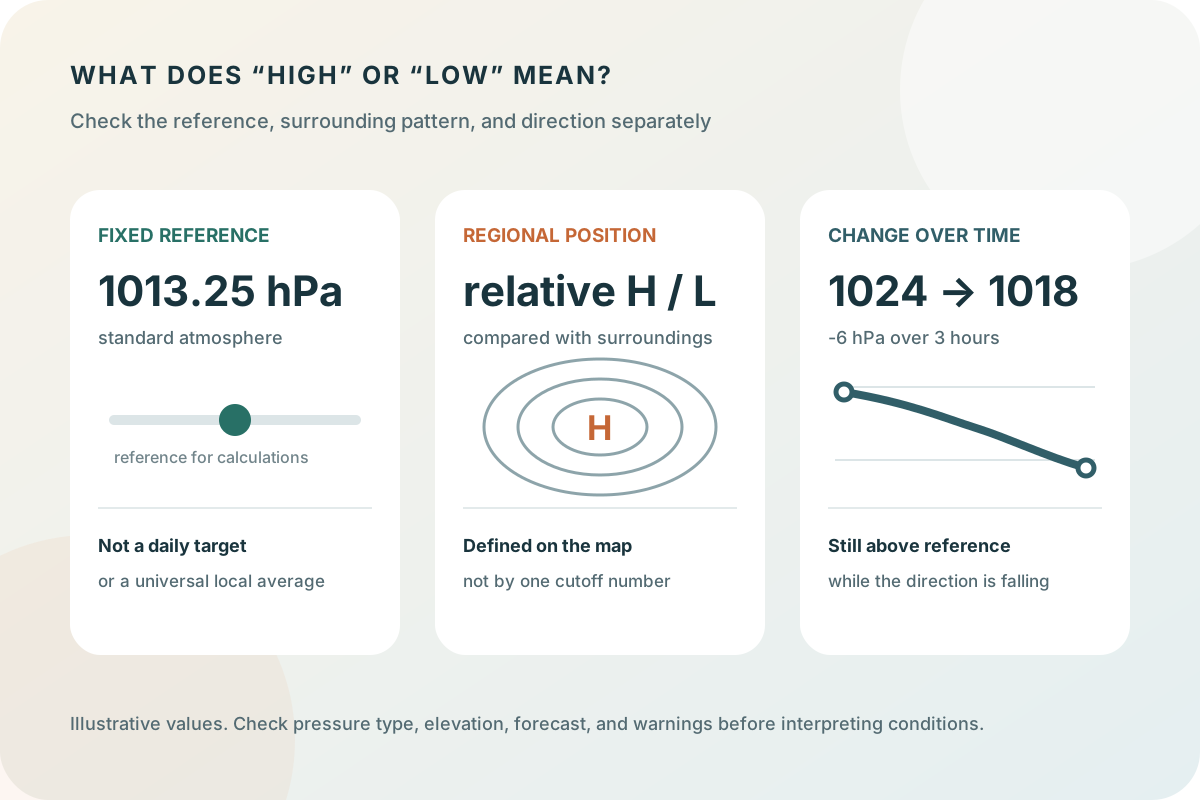
The standard atmosphere is a defined pressure of 101325 pascals. In everyday weather units, that is 1013.25 hectopascals. It provides a shared reference for measurements and calculations. Your mobile app may round it to 1013 hPa, while an instrument using inches of mercury shows approximately 29.92.
A local climatological average is different: it is calculated from measurements over a particular place and time period. A few days of app history can help you recognize recent conditions, but they do not establish a long-term climate normal. Being above the standard reference does not automatically mean a reading is unusual for your location or season.
| Unit | Standard reference |
|---|---|
| hPa (hectopascals) | 1013.25 |
| mbar (millibars) | 1013.25 |
| inHg (inches of mercury) | 29.92, rounded |
| mmHg (millimeters of mercury) | 760, approximately |
| Pa (pascals) | 101325 |
Key takeaways
- Standard atmospheric pressure is 1013.25 hPa, approximately 29.92 inHg or 760 mmHg.
- Compare like with like: surface pressure and sea-level pressure answer different questions.
- A local average requires observations for that location and period; it cannot be read from the standard atmosphere definition.
What is considered low barometric pressure?
A sea-level reading below 1013.25 hPa is below the standard reference. For example, 1000 hPa is about 29.53 inHg. However, meteorologists identify a low-pressure system by a pressure minimum relative to surrounding areas, not simply by checking whether a number crosses 1013.25.
Consider two illustrative readings of 1000 hPa. One has barely changed over several hours; the other has fallen from 1010 hPa during the same interval. Their current values match, but their recent histories do not. Neither example alone establishes the weather ahead. Check the forecast, wind, and official warnings rather than treating a fixed pressure threshold as a storm alarm.
A falling reading and a low reading also mean different things. Pressure can be falling while still above the standard reference, or rising while remaining below it.
What is high barometric pressure?
A sea-level reading of 1030 hPa, approximately 30.42 inHg, is above the standard reference. A high-pressure system is a relative maximum on a weather map. Its meaning depends on the surrounding pattern, not just the number on one barometer.
High-pressure systems often involve sinking air and can favor settled conditions. That is not a guarantee of clear skies, gentle winds, or safe outdoor conditions. Pressure alone does not describe visibility, temperature, waves, or a thunderstorm warning. Use the full forecast for the activity you are planning.
Why elevation changes the answer
Surface pressure is the air pressure at the instrument's actual elevation. There is less atmosphere above a mountain location than above the coast, so surface pressure generally decreases as elevation increases. A low raw reading at altitude is not automatically evidence of a low-pressure weather system.
Sea-level pressure adjusts a reading for elevation so weather conditions at different locations can be compared. Before comparing a phone with a weather station, check both pressure types and timestamps. Otherwise an apparent disagreement may simply be a comparison between raw pressure and an adjusted value.
Three checks before interpreting today's number
First, identify the units and pressure type. A value near 30 probably uses inHg rather than hPa; a mountain surface reading should not be compared directly with the sea-level reference. Do not convert a number without knowing its original units.
Second, compare readings at similar elevations and over a stated interval. An illustrative change from 1024 to 1018 hPa is a fall of 6 hPa even though both numbers are above the standard reference. A change from 998 to 1004 hPa is a rise of 6 hPa even though both remain below it. The direction and the current level are separate observations.
Third, check what the forecast says about your actual location and plans. In Barometer, history and notes help retain the context of an on-device measurement; the website's Today and Forecast tools show weather-provider data. Neither a colored label nor a single reading replaces an official weather warning.

