
What does high pressure mean in this context?
A weather high is an area with pressure higher than its surroundings. A sea-level number such as 1030 hPa is also above the standard atmosphere reference of 1013.25 hPa. Neither comparison defines a medical danger line. A forecast's sea-level pressure is adjusted for elevation and is not necessarily the actual air pressure surrounding your body.
Before interpreting an apparent connection, ask whether you mean a high absolute reading, a rising trend, or a sudden change. These are not equivalent exposures. Record the time and source so a forecast for tomorrow is not mistaken for a measurement from the time your symptoms began.
Key takeaways
- High weather pressure and high blood pressure are different measurements.
- Evidence about weather-sensitive symptoms is mixed and does not support predicting an individual's symptoms from one value.
- Use symptom notes as context for care, not as a reason to ignore new or severe symptoms.
Headaches and migraine: possible links, not a reliable rule
Some people report weather-related headaches, and observational studies have found associations with pressure measures. But a prospective diary study of 238 people found that initially observed weather associations, including one involving a high-pressure ridge, did not remain statistically significant after correction for multiple testing.
This does not dismiss a person's experience. It means the evidence should not be presented as a rule that high pressure causes migraine, or that low pressure is the only possible concern. Symptoms may overlap with changes in temperature, light, sleep, or other circumstances.
The separate headache article examines the pressure research in more detail, including studies finding associations with pressure drops. Use that explanation rather than treating the broad question of body effects as a second migraine-tracking guide.
Prospective migraine study: the importance of multiple-testing correction
Joint pain and other symptoms: avoid universal claims
Research on musculoskeletal pain does not produce a single dependable pressure rule. A 2019 smartphone study of people with chronic pain found a modest association between higher pressure and lower odds of a pain event, alongside associations with other weather variables. It was observational and does not establish that high pressure treats pain.
A 2024 meta-analysis of case-crossover studies found no pooled association between air pressure and the risk of rheumatoid arthritis, knee pain, or low back pain. These findings do not support a general claim that a high barometer reading will make joints hurt.
If you notice pain, fatigue, or another symptom on a high-pressure day, record it without assigning a cause. Repeated or troublesome symptoms deserve assessment on their own merits rather than being explained away by the weather.
2019 chronic-pain study: weather associations and limitations
Air quality may matter separately from pressure
High-pressure patterns with stagnant air can allow pollutants to accumulate. That is an indirect weather and air-quality relationship, not proof that the pressure reading itself caused a breathing symptom. Pressure alone cannot tell you the pollutant concentration where you are.
For air-quality concerns, check a local air-quality service and follow your clinician's advice for any respiratory condition. A barometer is not a substitute for an air-quality monitor, oxygen measurement, or a respiratory action plan.
Blood pressure, altitude, and chambers are different
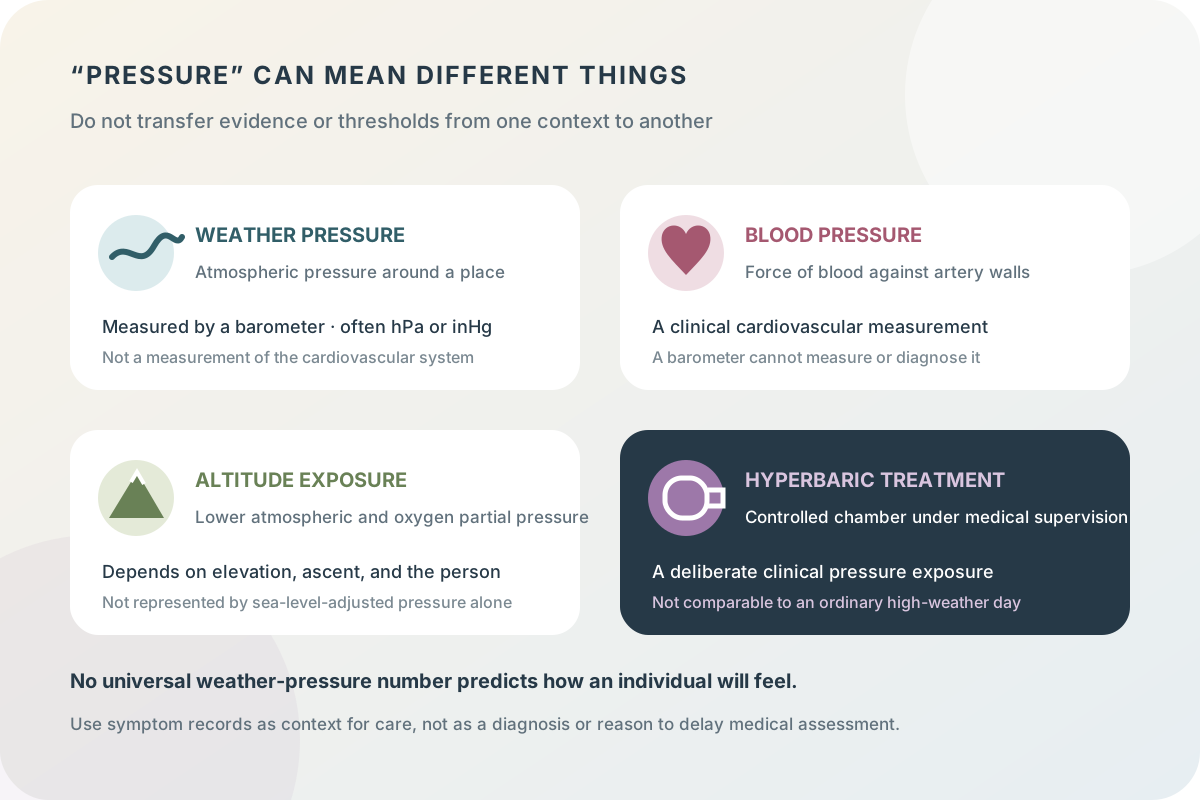
Blood pressure describes the force of blood against artery walls. Barometric pressure describes the surrounding air. Both may be expressed using mmHg, but that shared unit does not make the measurements interchangeable. A weather app cannot measure your blood pressure or determine whether your blood-pressure treatment is working.
At high altitude, lower oxygen partial pressure is a key concern. The CDC explains that the risk depends on factors including elevation and ascent. That situation cannot be assessed from a sea-level-adjusted weather number, which deliberately removes much of the elevation effect.
Hyperbaric oxygen therapy is another distinct setting: it involves breathing oxygen in a pressurized chamber under medical supervision. Evidence or precautions for such chambers should not be transferred directly to an ordinary high-pressure weather day.
American Heart Association: what blood pressure measures
Use the record to ask better questions
Keep the symptom description separate from the pressure observation. For example: 'felt unwell at 15:00; 1028 hPa; poor sleep; stayed indoors' preserves context without declaring that 1028 hPa caused the problem. Include days with similar readings when you felt well. Notes in Barometer can be attached to saved measurements; they are not clinical diagnoses.
Widgets and pressure-change alerts may help you notice when to record context, but the app does not forecast your health. If monitoring increases worry, reduce checking rather than trying to find a perfect safe pressure range. Do not change medication based on an app label.
Seek emergency care for sudden severe headache or new sudden neurological symptoms such as weakness or difficulty speaking. For persistent or changing symptoms, contact a healthcare professional. A high or low reading should never delay an assessment.

